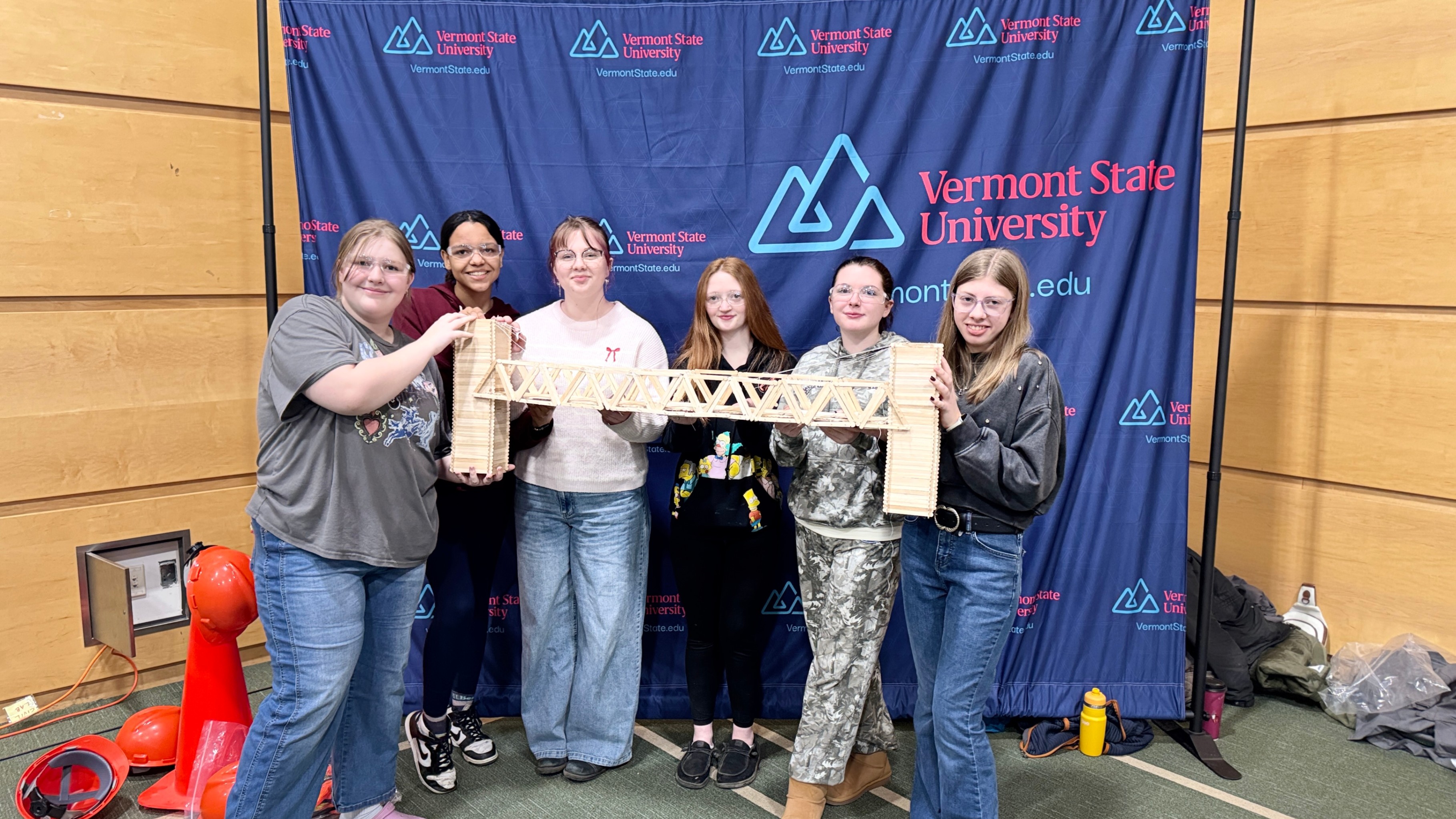
Hazen Union High School Team Competes in Bridge Building Competition
A team of Hazen Union High School students recently competed in the 2026 Popsicle Bridge Building Competition held at Vermont State University and sponsored by VTrans, marking their first time participating in an engineering event.
Engineering class students Bailey Clark, Willow Dyer, Lana Grant, Kai Merriam, and Kelyna VanLeuven designed and constructed a model bridge using only wooden popsicle sticks, Elmer’s glue, toothpicks, and dental floss. The competition challenges teams to create bridges capable of supporting as much weight as possible (load carrying capacity) while also being judged on aesthetics and originality of design, presentation, strength to weight ratio, and predicted failure point. Hazen Union’s bridge received third place for the lightest bridge. “This was one of our goals since bridges are ranked on efficiency or how much weight held compared to bridge mass,” said Marc Considine, Hazen Union teacher and team advisor. The bridge withstood 7.03 pounds of pressure before cracking during testing under a hydraulic press called the “Gordonator”.
When asked about designing a bridge in the future, Kai Merriam (grade 10) said, “I would make the walkway stronger. I would also add more toothpick supports and measure everything to make sure it is all straight and symmetrical.”
“The biggest challenge I faced while building the bridge was finding the weak points in the design and figuring out how to resolve them,” said Lana Grant (grade 10). “Participating in an engineering competition for the first time was really an exciting experience. I enjoyed building things and learning how engineering works. I really enjoyed working in a group, especially because everyone brought all their different opinions on what the bridge should look like and how it should be built. As a team, we were able to build a bridge that integrated a lot of different ideas.”
The event provides students with hands-on experience applying principles of math, science, physics, and engineering through real-world design challenges. Hazen plans to build on their experience this year, with some students already planning to enter next year’s competition—whether through a class or independently—and bring an even stronger structure, proving they’re already bridging the gap between classroom learning and real-world engineering.